 VOICE
VOICEBusiness information
Opening hours, services, locations, contact routes and approved FAQs.
HOW ORVIA VOICE WORKS
ORVIA Voice combines conversation, approved knowledge, rules, verified integrations and human escalation. The aim is to move routine work forward without giving automation authority it should not have.
THE CORE JOURNEY
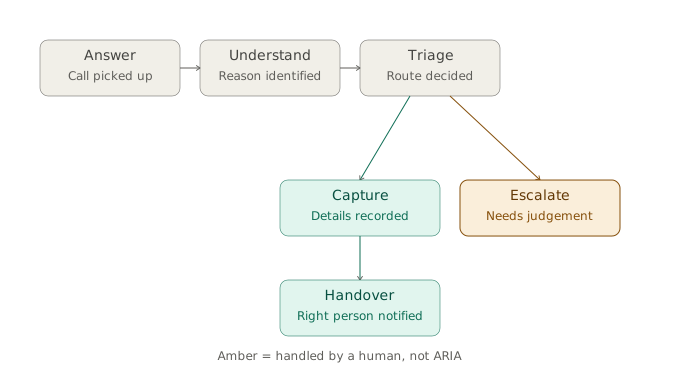
The detail changes by customer, but the operating model stays simple and controlled.
The configured assistant picks up using the agreed service identity and greeting.
ARIA identifies the reason for contact and asks the approved questions required for that journey.
The workflow uses approved knowledge, rules and escalation thresholds rather than inventing policy.
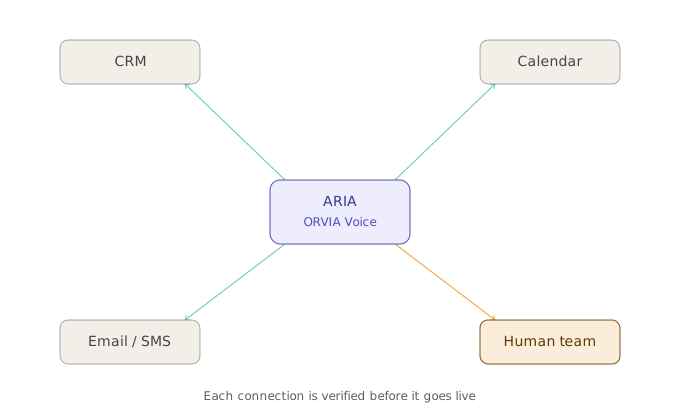
Where verified, Voice can route, capture, book, notify, create a task or update an agreed system.
A person receives the context when judgement, authority, complexity or sensitivity requires them.
KNOWLEDGE & RULES
During onboarding we agree business information, call reasons, approved questions, permitted actions, escalation thresholds and fallback behaviour.
Opening hours, services, locations, contact routes and approved FAQs.
The questions to ask for each common reason for contact.
What Voice may answer or action and what must be handed to a person.
Named people, teams, transfer routes or callback processes for exceptions.
INTEGRATIONS
We identify the system and required action, verify access and permissions, test normal and failure behaviour, then describe the connection as active only when it has actually been verified.
EXAMPLE CALL
Good morning. You're through to Northfield Services. How can I help?
I need to change tomorrow's appointment because I won't be home.
I can help capture the change. Can I take your name and the postcode on the booking?
Sam Carter, S71 2AB.
PROOF OF OUTPUT
HUMAN FIRST · HUMAN LAST
ORVIA Voice is designed for repeatable communication and administration. It is not positioned as the final decision-maker for safeguarding, legal, clinical, financial, regulatory or other consequential matters.
People approve the knowledge, rules, actions and escalation thresholds.
The repeatable middle: conversation, structured capture and permitted routine actions.
Defined thresholds interrupt automation and hand the matter to an accountable person.
FAILURE BEHAVIOUR
The workflow should clarify, retry within defined limits or hand over rather than manufacture certainty.
The deployment needs a fallback such as capture for manual review rather than pretending the action completed.
Yes. Call reasons, knowledge, actions and escalation rules can be reviewed as the organisation learns from real demand.
Deployments can report call reasons, outcomes, actions and human handovers so the organisation can see where people remain essential.
See what we need from you, how testing works and what happens before go-live.